We are reader-supported. When you buy through links on our site, we may earn affiliate commission.
You have likely seen invasive species permeate your local neighborhoods or state, but you may not have recognized them. Many invasive plants, especially, can be deceptive in how threatening they are, especially if they are beautiful or unassuming. They may blend in well with their surroundings. One of the most widespread in the U.S. is a vine called kudzu. Is kudzu really invasive, and is it that bad? If you find it, what can you do about it?
Kudzu, or Pueraria montana, is a vine species introduced to the American South in 1876. It also known as the mile-a-minute vine because of how fast it grows. On a good day, it can extend up to a foot in length. It is a perennial originating from Japan and southern China. It came into the U.S. for an unimpressive reason — people thought it was pretty. It was considered ornamental and had a pleasant scent.
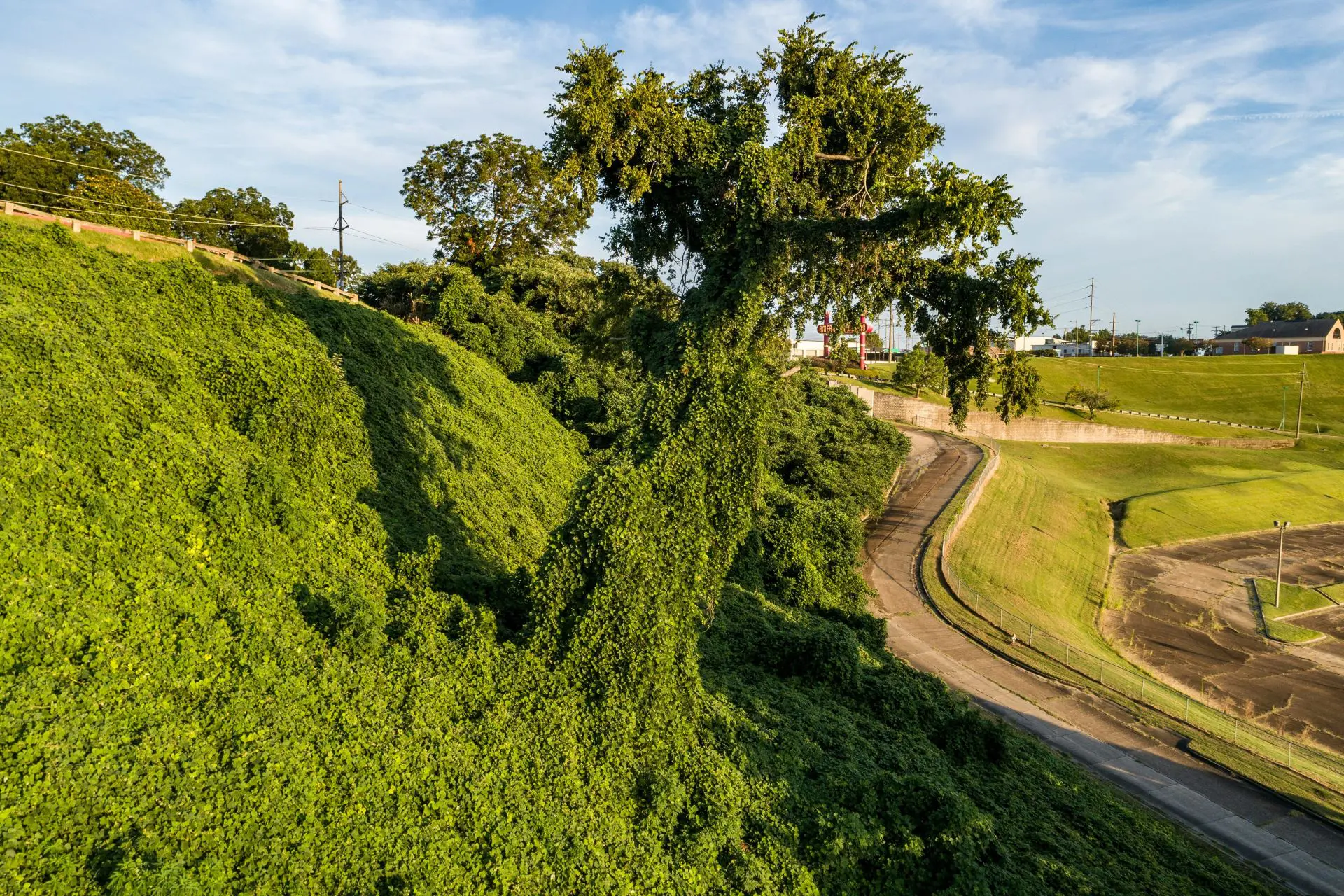
How can you identify kudzu? It is lush and green, and you may be able to go outside your door to a nearby wooded area or a park and see what appears to be a wall of leaves surrounding shrubs and trees. While they look like leaves, they blanket the surrounding flora, making them easy to spot wherever you go. The leaves are oval-shaped, and when they bloom, they have red and purple flowers.
Kudzu spread outside of the southern U.S. for several reasons. People recognized it as aesthetically pleasing, but a Florida farmer also noticed that his animals were eating its excess growth. C. E. Pleas became an advocate for kudzu as a forage crop, to the point that he was making pamphlets about it. Its value as a feedstock for cows, pigs, and goats grew.
Additionally, the Soil Conservation Service saw another opportunity with the plant. Because its vines are sturdy and hardy, the organization promoted kudzu as a solution for soil erosion and as a cover crop. It was fast-growing and durable, so it is understandable why it was thought to affordably keep soils in place. However, both efforts combined led to a rapid spread of the plant beyond everyone’s control.
Eventually, it led even organizations like the U.S. Department of Agriculture to advise everyone to stop using it on farms as early as the 1950s. Eventually, it became common knowledge that this plant, while edible, robust, and pretty, was overrunning everything in its sights. Everyone was so distracted by its novelty and by how its traits could support the nation that they were unable to notice how quickly it was taking over.
It can take a lot of effort and time to fully remove kudzu from an area, but it is possible. So, what can you do to help the environment?
The reason kudzu is hard to eradicate is its extensive root system. You have to know the plant’s behaviors and how it grows so you can understand how deep you might have to go to fully uproot it. Pulling it from shallow soil may not do the job, leading to more work later.
While many environmentalists oppose chemical control, the situation is different with invasive species. Fortunately, there are more eco-friendly herbicide options, but sometimes, extreme measures may be necessary to rescue what native wildlife remains. Spraying it multiple times over a patch can reduce the plant’s resilience, stopping it from spreading.
Repeated cutting can stress the kudzu’s roots, deteriorating them to the point that it will eventually stop growing. You will eventually sap it of nutrients and halt its growth. You have to do this regularly, and it could even take several years if this is the only method of attack.
You can dig far enough into the ground until you find the kudzu’s root and take it out by hand. This is one of the most surefire ways to stop kudzu in its tracks because you’re getting it from the source. It is labor-intensive and sometimes destructive to soils. However, it is worth it in the long term. Even if you remove some, you may have to spend several seasons taking them out one by one, because it is impossible to know when seeds have spread.
Just like Pleas noticed early in kudzu’s American takeover, animals can safely consume kudzu. This is a helpful supplement to other removal efforts, especially since they can dig and yank the plant out by its roots. Fortunately, humans can also eat kudzu, and many have found creative ways to prepare it.
Because it is an invasive species, sometimes severe measures need to be taken. In the most extreme situations, you can burn kudzu to get rid of anything aboveground. However, this should not be a method DIYers attempt. It may even be illegal to, so be careful and research your area to see what the regulations are.
Inquire with your local agricultural and invasive species organizations to see whether professionals are available to address this issue. Their expertise is invaluable in preventing fires from spreading and damaging surrounding infrastructure and wildlife. This process will remove the thick accumulation, exposing the root crowns below for the next phase of removal.
Sometimes invasive species can be eliminated by introducing a stronger species to compete with them. However, governments strongly advise against biological removal. No sustainable option has been discovered, though experts are experimenting with insect varieties that could be suitable.
While kudzu may appear harmless and even beautiful at times, it is an invasive species at its core and should be removed at all costs. The damage it causes is not worthy any benefits it could provide, as it stamps out native species with little resistance. To preserve biodiversity and maintain ecosystem balance, everyone must do their part by reporting kudzu’s presence and removing it when they can.