We are reader-supported. When you buy through links on our site, we may earn affiliate commission.
Wood scraps and crop leftovers might seem like unlikely ingredients for a sustainability staple. Nevertheless, biochar, a charcoal-like material made from organic waste, is attracting interest for its potential to store carbon, support soil health, and capture pollutants. How it’s made helps explain its growing role in carbon storage, gardening, and environmental cleanup.
Biochar is a stable, carbon-rich solid made by heating crop waste, manure, or other organic material in a low-oxygen environment. Penn State Extension explains that this treatment drives off much of the material’s oxygen, leaving a charcoal-like substance containing 50% to 80% carbon. The high carbon content makes biochar stable and long-lasting.
Biochar has tiny pores throughout, with more porous types performing well as filters that capture contaminants. Some types resist getting wet at first, so gardeners should ask suppliers whether soaking the product before application would help. Mixing it with compost, often called charging, is another preparation step that supplies nutrients before the biochar goes into the soil.
Biochar production is picking up across the United States. The American Biochar Institute’s survey-based market estimates show output rising from 86,893 metric tons in 2023 to 151,329 in 2025, while estimated market value grew from $53.6 million to approximately $157 million.
Biochar is made by heating organic material in a low-oxygen environment, a process called pyrolysis. The material goes into an oven-like device called a retort, where heat breaks it down without enough oxygen for it to burn freely.
Producers can use a dry process, similar to controlled roasting, or a wet process called hydrothermal processing. Dry processing generally costs less, while wet processing can suit materials with high moisture content, such as manure or food waste.
According to Penn State Extension, the amount of heat changes the material in several ways:
Heating speed, treatment time, and equipment also affect the finished product. More intensive processing generally leaves less solid material behind but concentrates its carbon. Depending on the process, the remaining amount can range from 90% to 10% of the original dry weight.
Biochar’s carbon starts in the atmosphere. As plants grow, they absorb carbon dioxide through a process called photosynthesis and use its carbon to build their tissues. When plants decay or burn, much of that carbon returns to the atmosphere relatively quickly.
Turning plant material into biochar keeps some of that carbon stored in a solid form, a process called carbon sequestration. Penn State Extension cites estimates that biochar can last for at least 1,000 years, with some studies suggesting an average lifespan of 5,000 years.
Biochar has the potential to be carbon-negative when it stores more carbon than its production and use release. Moreover, it can replace some fossil-sourced carbon in products and industrial applications, reducing reliance on coal and petroleum.
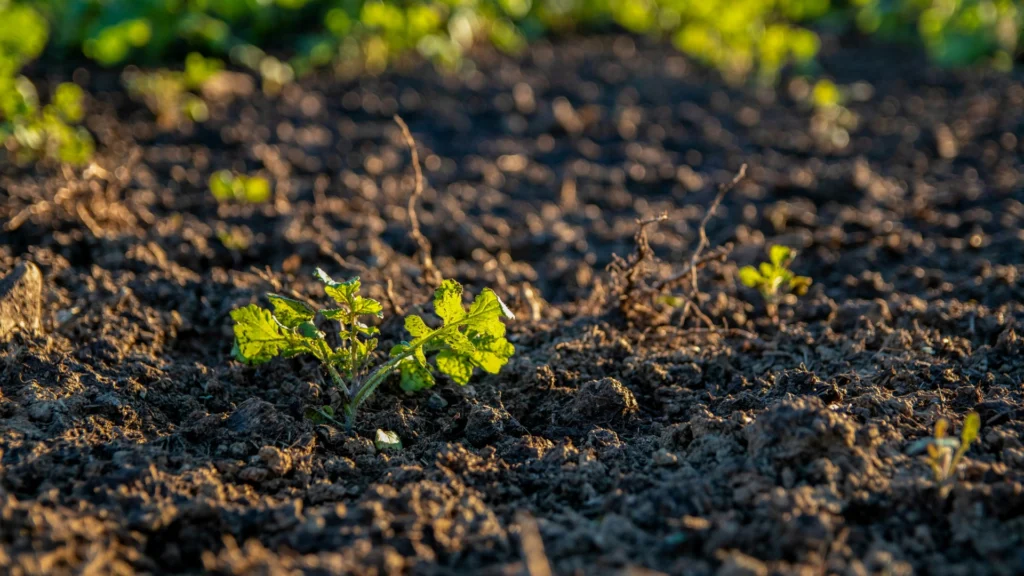
Biochar can help improve soil structure by creating more space between particles in compacted ground. Air and water can move through these spaces more easily, giving roots room to grow. In a study across 3 national forests, surface-applied biochar reduced soil bulk density, a measure of compaction, by 18% to 19% in the upper 10 centimeters after 1 year.
Biochar’s internal pores act like tiny sponges, holding water and dissolved nutrients that might otherwise drain away. The moisture can remain available to plant roots as the surrounding soil dries. It also contributes a long-lasting form of organic matter, another factor in water retention. A 1% increase in soil organic matter can boost plant-available water by 16,500 gallons per acre.
Getting these benefits in a garden starts with choosing a suitable product. Gardeners can ask suppliers about the feedstock, production temperature, particle size, and hydrocarbon content, since even trace amounts can harm plants. Since some biochars repel water, it’s also useful to check whether preparation is needed before working them into the soil.
Biochar can capture pollutants when they stick to its surface, a process called adsorption. Its many pores provide space to bind heavy metals, toxic chemicals, and pesticides, helping limit their movement through soil and water. Potential uses include abandoned mine sites, roadside runoffs, and stormwater basins.
It can also work like activated carbon, filtering contaminants from liquids and gases. Applications include odor control for manure and municipal wastewater treatment. However, the same binding ability can cause problems in agricultural soil, where certain biochars can trap herbicides and reduce their effectiveness.
Gardeners can check the weedkiller’s label to see whether it works through the soil. If it does, they can contact the manufacturer before applying biochar, sharing the product’s specifications and planned application rate to check for possible interference.
Recovering loose biochar after treatment can be difficult. Researchers have addressed this by making solid biochar filtration boards, using natural binders such as lignin, starch, and tannins to hold the particles together. The boards can sit in contaminated water and then be removed.
In laboratory tests, the boards captured all the mercury in water containing 2 parts per million after 48 hours. Separate tests showed they also captured all the cadmium, chromium, and lead in 24 hours, starting at concentrations of 30 – 50 parts per million.
Early tests also showed promise for perfluorooctanoic acid (PFOA), one compound in the group known as per- and polyfluoroalkyl substances (PFAS). PFOA levels fell by about 95% after 1 hour and 97% after 24 hours, dropping from roughly 70.5 to 1.7 parts per trillion.
From garden beds to water filters, biochar offers several ways to put organic waste to use. Storing carbon, supporting healthier soil, and capturing pollutants all hold promise, though each application calls for a suitable product. With research continuing, gardeners and communities have good reason to explore biochar’s potential.